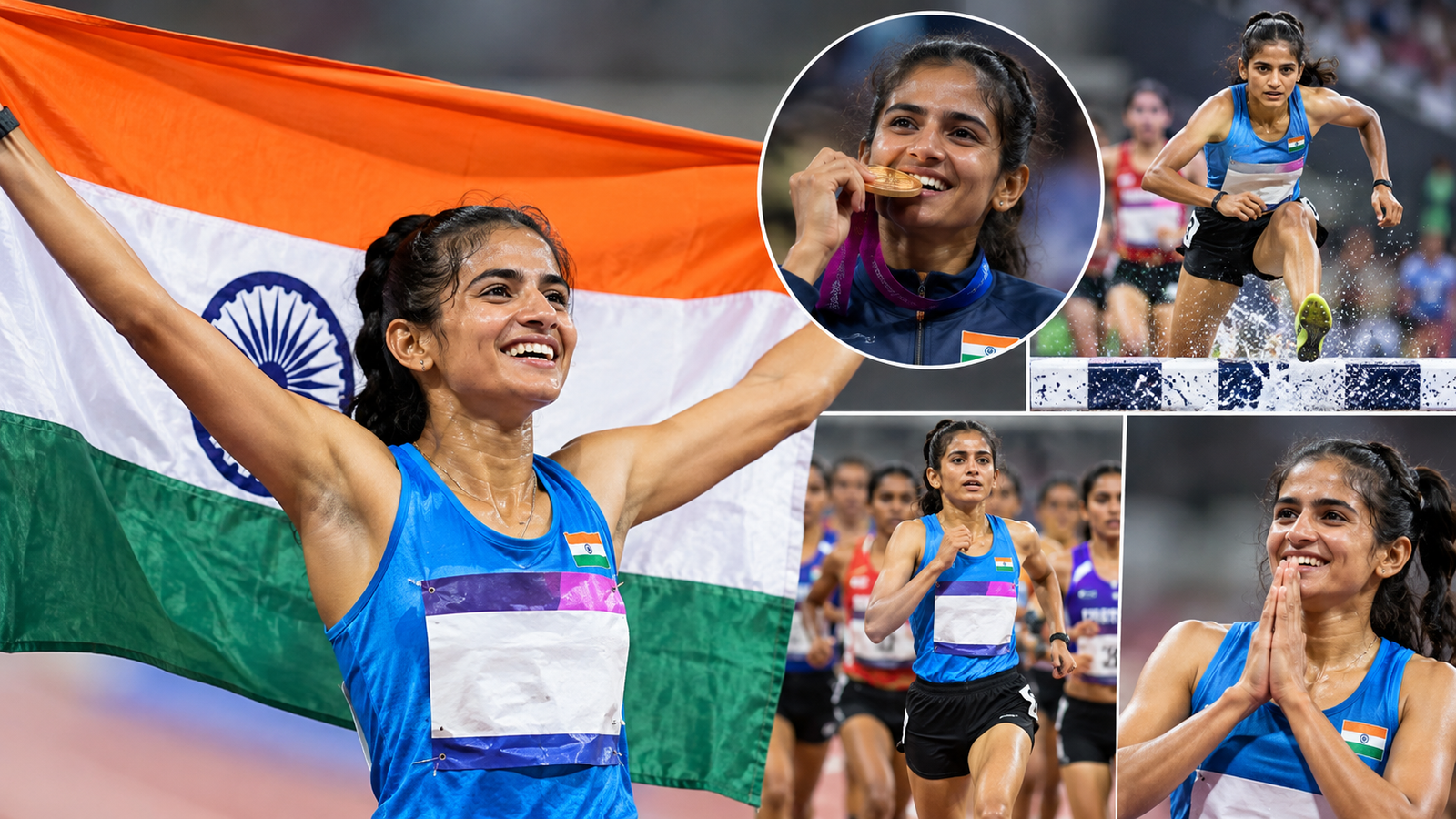
Ankita Dhyani meet record became the headline achievement at the 65th National Open Athletics Championships after the Indian distance runner won the women’s 3000m steeplechase in 9:34.86. Representing Railways, she broke the previous championship record of 9:39.83, set by Lalita Babar in Kolkata in 2015.
The performance came on the final day of the championships at Jawaharlal Nehru Stadium in New Delhi. Dhyani’s winning time improved the previous meet record by 4.97 seconds, establishing a new benchmark for the event at this competition.
The Ankita Dhyani meet record is a notable result for Indian athletics because the previous championship mark had stood for more than a decade. Although the performance did not break the Indian national record, it secured Dhyani the gold medal and added an important milestone to her competitive career.
Key Highlights
- Gold medal: Ankita Dhyani won the women’s 3000m steeplechase representing Railways.
- Winning time: She completed the race in 9:34.86.
- Previous record: Lalita Babar’s 9:39.83 mark from 2015 was surpassed.
- Second place: Mori Vandana of Gujarat finished in 10:00.02.
- Third place: Komal Jagadale of Railways finished in 10:05.34.
Athletics Federation of India
Table of Contents
- What Happened?
- Important Details
- Why Is This News Important?
- Latest Updates
- Official Statement and Source
- Background and Context
- Reactions and Public Response
- What Happens Next?
- Frequently Asked Questions
- Conclusion
What Happened?
The Ankita Dhyani meet record was established during the women’s 3000m steeplechase at the 65th National Open Athletics Championships. Dhyani won the event in 9:34.86, improving the previous championship record and taking gold for Railways.
The Athletics Federation of India reported that Dhyani controlled the race from start to finish. Her performance surpassed Lalita Babar’s record of 9:39.83, which had been set at the 2015 National Open Athletics Championships in Kolkata.
Breaking a championship record requires an athlete to outperform the previous best mark recognised for that competition. Dhyani achieved that with a time nearly five seconds faster than Babar’s earlier benchmark.
The result was one of the notable performances on the final day of the championships. The event also featured other strong performances across track and field, with athletes competing for medals and seeking to establish their places in the national athletics calendar.
How Dhyani improved the record
Dhyani’s time of 9:34.86 was 4.97 seconds faster than the previous record of 9:39.83. The difference can be calculated directly from the two officially reported times.
In a 3000m steeplechase, runners must maintain their pace while clearing barriers and negotiating water jumps. These obstacles make the event technically demanding, requiring endurance, coordination and consistent rhythm.
The final result confirms that Dhyani produced a faster championship performance than any previous women’s steeplechase competitor at this meet. However, the available report does not provide detailed lap splits or obstacle-by-obstacle timings, so those aspects of her race cannot be assessed precisely.
The medal-winning performances
The top three athletes produced the following results:
| Position | Athlete | Team | Time |
|---|---|---|---|
| Gold | Ankita Dhyani | Railways | 9:34.86 |
| Silver | Mori Vandana Bharat | Gujarat | 10:00.02 |
| Bronze | Komal Jagadale | Railways | 10:05.34 |
Source: Athletics Federation of India official results.
Dhyani finished 25.16 seconds ahead of the silver medallist. That margin shows the difference between the athletes’ final times, while the official report’s description of a start-to-finish performance provides additional context about her race.
Important Details
Who is Ankita Dhyani?
Ankita Dhyani is an Indian distance runner who competes in events including the 3000m steeplechase. She has also competed in other distance-running events, including the 5000m.
Her results in international university and continental competitions provide context for her development as a competitive athlete. Her 2026 National Open Athletics Championships victory adds another achievement to her record.
The latest win came while she represented Railways, an institutional team that competes in Indian athletics events. The championship result confirms her position as the gold medallist in this particular race.
When and where did the record happen?
The performance took place at Jawaharlal Nehru Stadium in New Delhi during the 65th National Open Athletics Championships, held from October 8 to October 11, 2026. The official results page identifies the venue and competition dates.
The Athletics Federation of India published its report on October 12, 2026. That publication date should be distinguished from the date of the competition itself, which concluded on October 11.
What is the women’s 3000m steeplechase?
The women’s 3000m steeplechase is a distance-running event that combines track running with fixed barriers and water jumps. Competitors must cover the prescribed distance while clearing the obstacles efficiently.
The event requires aerobic endurance, pace control and technical ability. Runners must manage their energy throughout the race while maintaining a consistent rhythm across the barriers.
Unlike a flat 3000m race, the steeplechase adds repeated interruptions to the running stride. Athletes need to approach obstacles confidently and recover their rhythm quickly after each clearance.
These demands help explain why a strong time in the event reflects several aspects of performance rather than speed alone.
What is the difference between a meet record and a national record?
A meet record is the best recognised performance at a specific competition. A national record is the best recognised performance for a country in that event under the relevant governing body’s rules.
An athlete can therefore break a championship record without setting a national record. Dhyani improved the National Open Athletics Championships mark, but the Indian national record remained a separate benchmark.
The distinction matters because the word record can refer to several different achievements. Accurate sports reporting should identify whether a performance is a meet record, national record, continental record or world record.
Why Is This News Important?
A long-standing championship mark has been improved
The previous meet record had stood since 2015. Dhyani’s performance brought that period to an end, giving the women’s steeplechase a new championship benchmark.
Records provide a way to compare performances across different editions of a competition. When a mark stands for several years, breaking it becomes a significant part of the event’s history.
The achievement does not automatically prove that the standard of the entire event has improved across India. It does, however, establish that Dhyani produced a faster performance than the previous recognised championship mark.
A significant result for Indian distance running
Indian athletics includes athletes across sprinting, middle-distance running, long-distance events, jumps and throws. Results in the steeplechase help document progress in one of the sport’s more technically demanding distance events.
Dhyani’s performance gives coaches, athletes and fans a clear result to compare against in future editions. It also adds another record-breaking achievement to the country’s domestic athletics coverage.
Readers following [Latest Sports News] can place this result alongside other Indian and international athletics developments to understand the wider competitive picture.
A useful benchmark for future competitors
The time of 9:34.86 becomes the new mark to beat at the championship, subject to the event and record category remaining recognised in future editions.
Upcoming competitors can use the result as a reference when assessing their own performances. It also gives the event a clear historical comparison with Babar’s 2015 record.
However, the record does not guarantee that the mark will remain in place for another decade. Future results will depend on the performances of the athletes who enter subsequent championships.
Why the national record still matters
The AFI results page lists Parul Chaudhary’s national record at 9:08.67. That time is faster than Dhyani’s 9:34.86 championship-winning performance.
Dhyani’s result should therefore be described as a meet record rather than an Indian national record. Both achievements are important, but they represent different levels of recognition.
Maintaining this distinction allows readers to understand exactly what changed at the championships without exaggerating the scope of the achievement.
Latest Updates
The confirmed timeline for the Ankita Dhyani meet record is as follows:
- 2015: Lalita Babar set the previous championship record of 9:39.83 in Kolkata.
- October 8–11, 2026: The 65th National Open Athletics Championships took place at Jawaharlal Nehru Stadium in New Delhi.
- October 11, 2026: Dhyani won the women’s 3000m steeplechase in 9:34.86 on the final day of the competition.
- October 12, 2026: The Athletics Federation of India published its report confirming the record-breaking result.
These dates and results are supported by the AFI’s official coverage and competition results.
No specific next race or new selection decision is confirmed in the cited report. Readers should rely on official announcements for any future competition details.
Official Statement / Source
The primary source for this article is the Athletics Federation of India, India’s national governing body for athletics.
The federation confirmed Dhyani’s winning time of 9:34.86 and stated that it bettered Lalita Babar’s previous meet record of 9:39.83.
In a post-race interaction reported by the federation, Dhyani said:
“I could have clocked better time. But there was no one to challenge me in the race today.”
The comment reflects Dhyani’s own assessment of the competition. It should not be interpreted as proof of what her time would have been in a different field or under different conditions.
Athletics Federation of India
For the official finishing order and record information, readers can consult the AFI championship results page.
Background / Context
Lalita Babar’s championship record
Lalita Babar set the previous women’s steeplechase meet record at the National Open Athletics Championships in Kolkata in 2015. Her time of 9:39.83 remained the recognised championship mark until Dhyani’s performance in 2026.
Babar is an established Indian distance runner, and her record forms part of the history of the event. Dhyani’s performance connects two different periods of competition at the same championship.
The comparison is straightforward: the previous record was 9:39.83, while the new record is 9:34.86. The improvement was 4.97 seconds.
The available official report does not provide a detailed comparison of track conditions, weather, pacing or competition depth between the two races. Those factors should not be assumed when discussing why the record changed.
The technical demands of steeplechase running
The 3000m steeplechase is different from a conventional distance race because runners must negotiate obstacles throughout the event. Each barrier and water jump requires coordination as well as the endurance needed to sustain the running pace.
Athletes need to approach each obstacle without losing excessive momentum. They must also recover quickly and return to an efficient stride, particularly in the later stages when fatigue can affect technique.
Pace management is another important factor. Starting too quickly can make it difficult to maintain speed later, while a controlled effort can help a runner preserve energy for the entire distance.
These general characteristics explain why the event tests more than raw running speed. They do not, however, reveal the exact strategy Dhyani used, because detailed race splits have not been included in the cited report.
Dhyani’s wider competitive background
Dhyani has competed at international competitions, including university-level and continental events. Her previous results provide context for the 2026 domestic championship victory.
The latest record should be understood as one milestone within her career. A single result cannot determine future performance, but it provides a verified benchmark against which later races can be compared.
For Indian athletics coverage, the value of maintaining accurate athlete profiles and event results is considerable. It allows readers to follow individual progress over time without confusing a single championship result with a broader career trend.
The role of national championships
National championships allow athletes representing states and institutional teams to compete in a common event structure. They also provide a formal record of finishing times, medals and competition marks.
The Athletics Federation of India publishes results and event reports that can be used to verify performances. Readers interested in [Indian Athletics News] can consult these records to follow other disciplines and future competitions.
Accurate reporting requires attention to the event name, the athlete’s representation and the category of record being discussed. A meet record should not be described as a national record unless the official evidence supports that claim.
Dhyani’s result provides a clear example of why these details matter: the official report confirms the new meet record while separately identifying the national record.
Reactions and Public Response
The confirmed post-race reaction available in the AFI report came from Dhyani herself. She said she believed she could have recorded a better time because she did not face a strong challenge during the race.
Her comment provides insight into her assessment of the competition. It also indicates that she felt the performance could potentially have been faster, though no alternative time was established.
The available source does not provide a verified collection of public reactions from fans, coaches or other athletes. Consequently, it would be inappropriate to attribute specific opinions to those groups without further evidence.
The confirmed achievement remains the central point: Dhyani won gold and set a new championship record.
What Happens Next?
Dhyani’s next competition has not been confirmed in the cited report. Future performances and official announcements will provide more information about her upcoming schedule.
Her record-breaking result gives her a new championship benchmark, but it does not guarantee another record or a particular selection outcome. Those developments would need to be established by subsequent results and official announcements.
Readers can follow the official AFI website for competition information and published results. The federation’s announcements are the appropriate source for confirming future events, selections and record updates.
For now, the verified result is clear: Dhyani won the women’s 3000m steeplechase in 9:34.86, improving the previous meet record by 4.97 seconds.
Frequently Asked Questions (FAQs)
1. What is Ankita Dhyani’s meet record?
Ankita Dhyani’s meet record is 9:34.86 in the women’s 3000m steeplechase. She recorded the time while representing Railways at the 65th National Open Athletics Championships in New Delhi in October 2026.
2. When did Ankita Dhyani break the steeplechase record?
Dhyani set the new record on the final day of the 65th National Open Athletics Championships, October 11, 2026. The Athletics Federation of India published its report on October 12, confirming her winning time and the previous championship record.
3. Who held the women’s steeplechase meet record before Ankita Dhyani?
Lalita Babar held the previous National Open Athletics Championships record. She recorded 9:39.83 in Kolkata in 2015. Dhyani improved that mark by 4.97 seconds with her 9:34.86 performance in New Delhi.
4. Did Ankita Dhyani break India’s national record?
No. Dhyani broke the championship meet record, not the Indian national record. The official AFI results list Parul Chaudhary’s national record at 9:08.67. The two marks represent different record categories.
5. Where did Ankita Dhyani set the meet record?
Dhyani established the new championship mark at Jawaharlal Nehru Stadium in New Delhi. The performance came during the 65th National Open Athletics Championships, held from October 8 to October 11, 2026.
6. Why is the Ankita Dhyani meet record important?
The Ankita Dhyani meet record is important because it replaced a championship mark that had stood since 2015. Her time of 9:34.86 established a new benchmark for the women’s 3000m steeplechase at the National Open Athletics Championships.
7. Who finished second and third behind Ankita Dhyani?
Mori Vandana Bharat of Gujarat finished second in 10:00.02, while Komal Jagadale of Railways finished third in 10:05.34. The Athletics Federation of India published both times in its official championship results.
8. What is Ankita Dhyani’s next competition?
Her next competition has not been confirmed in the cited report. Readers should check official Athletics Federation of India announcements for schedule updates. A specific upcoming race should not be stated as confirmed until reliable information becomes available.
Conclusion
Ankita Dhyani delivered a record-breaking performance at the 65th National Open Athletics Championships, winning the women’s 3000m steeplechase in 9:34.86. Her result improved Lalita Babar’s previous championship mark of 9:39.83, set in 2015.
The Ankita Dhyani meet record is a significant milestone in the history of the competition and an important result for Indian athletics. It also demonstrates why championship records and national records must be reported separately.
The main takeaway is clear: Dhyani won gold, established a new meet record and added another achievement to her career. Her future results will show how she builds on this performance.
For more latest sports news, match updates, and breaking sports stories, visit WorldPlayHub.