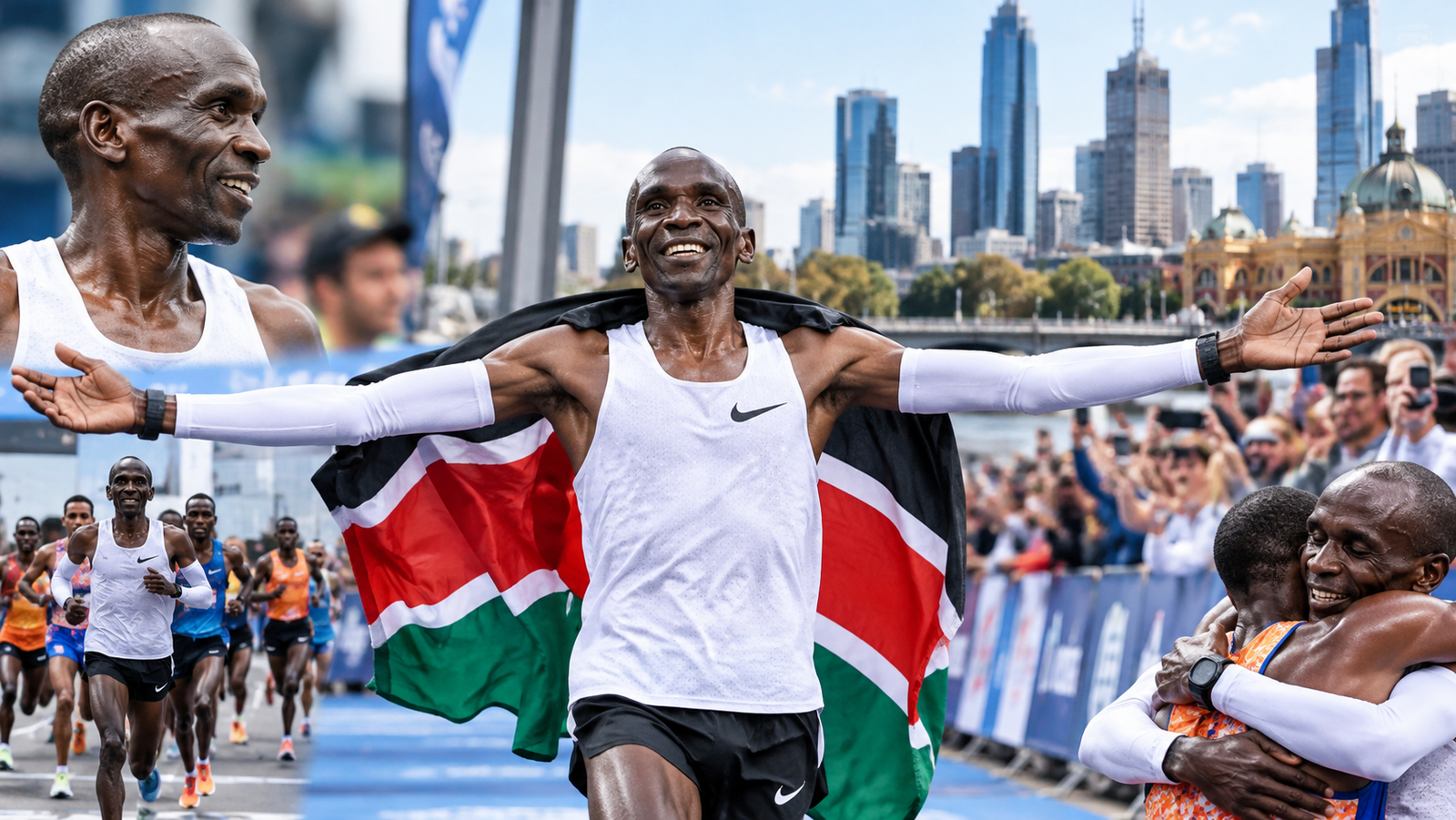
Eliud Kipchoge Melbourne Marathon was the headline story of the 2026 Nike Melbourne Marathon Festival after Kenyan distance-running legend Eliud Kipchoge won the men’s race in 2:09:10 on 11 October 2026 in Melbourne, Australia. His performance established a new course record and marked his first marathon victory since Berlin in 2023.
The Eliud Kipchoge Melbourne Marathon result attracted international attention because the two-time Olympic marathon champion returned to the winner’s position at the age of 41. Australian runners Thomas Do Canto and Reece Edwards completed the men’s podium, while the finish inside the Melbourne Cricket Ground (MCG) added historical significance to the event. Official World Athletics results
For athletics followers, the Eliud Kipchoge Melbourne Marathon victory was more than a first-place finish. It combined a record-setting time, a strong home challenge from Australian competitors and a memorable appearance at one of the country’s best-known sporting venues.
Key Highlights
- Eliud Kipchoge won the men’s marathon in 2:09:10.
- The Eliud Kipchoge Melbourne Marathon result established a course record, improving the previous mark by two seconds.
- Thomas Do Canto finished second in 2:10:35.
- Reece Edwards took third place in 2:14:33.
- The race took place on 11 October 2026 and finished inside the Melbourne Cricket Ground.
Table of Contents
- What Happened?
- Important Details
- Why Is This News Important?
- Latest Updates
- Official Statement and Sources
- Background and Context
- Reactions and Public Response
- What Happens Next?
- Frequently Asked Questions
- Conclusion
What Happened? Eliud Kipchoge Melbourne Marathon Victory
The Eliud Kipchoge Melbourne Marathon victory became official when the Kenyan crossed the finish line in 2:09:10. The full marathon covered the standard distance of 42.195 kilometres, and Kipchoge finished ahead of two Australian competitors in the men’s elite race.
According to ABC News race coverage, Kipchoge moved clear of his challengers during the final 10 kilometres. That decisive phase helped him establish an advantage that he maintained through the finish.
The Eliud Kipchoge Melbourne Marathon performance was particularly notable because he was making his first appearance at the Melbourne event. Rather than simply completing a race in a new location, he left Australia with the victory and a new mark for the course.
A decisive finish
Marathons require athletes to balance speed, endurance and energy management across more than 42 kilometres. A strong opening pace is not enough by itself; runners must also preserve their ability to respond when the competition intensifies late in the race.
In Melbourne, Kipchoge’s late move proved decisive. The Eliud Kipchoge Melbourne Marathon result reflected his ability to sustain a competitive pace and separate himself from the other leading runners when the race entered its final stage.
The available race reports confirm the move inside the final 10 kilometres, but they do not establish every tactical decision made by the athletes throughout the race. It is therefore more accurate to describe the late acceleration as the decisive development than to invent a detailed account of conversations, team instructions or strategy.
Australia’s runners finish on the podium
Thomas Do Canto finished second in 2:10:35, while Reece Edwards took third in 2:14:33. Their results gave Australia two places on the men’s podium behind the Kenyan champion.
The gap between Kipchoge and Do Canto was one minute and 25 seconds. This margin shows that Kipchoge established a meaningful lead, although Do Canto also produced a competitive performance over the full marathon distance.
The Eliud Kipchoge Melbourne Marathon result brought international attention to the podium, but the Australian finishers were an important part of the race story. Their performances provided a local dimension to a contest led by one of the most recognisable names in long-distance running.
A finish inside the Melbourne Cricket Ground
The race route passed through Melbourne and included well-known landmarks before runners reached the MCG. The stadium finish gave participants an opportunity to complete the event in a major sporting venue.
The Eliud Kipchoge Melbourne Marathon finish also connected the 2026 event with Melbourne’s Olympic history. The MCG hosted the start and finish of the marathon during the 1956 Olympic Games, creating a meaningful link between the modern race and the city’s sporting past.
Important Details
Who won the race?
Eliud Kipchoge of Kenya won the men’s marathon. He is a two-time Olympic marathon champion and a former men’s marathon world-record holder.
His reputation was established through years of success in international distance running. The Eliud Kipchoge Melbourne Marathon victory added another marathon win to that career and demonstrated his continuing competitiveness at the elite level.
When and where did the race take place?
The marathon was held on Sunday, 11 October 2026, in Melbourne, Victoria, Australia. It formed part of the Nike Melbourne Marathon Festival, a multi-event running weekend that included races at different distances.
The official event information lists the full marathon distance as 42.195 kilometres, with the start on Batman Avenue and the finish at the Melbourne Cricket Ground. Details are available through the official Melbourne Marathon website.
What was the winning time?
Kipchoge completed the race in 2:09:10. The Eliud Kipchoge Melbourne Marathon time was two seconds faster than the previous men’s course record, according to event reporting.
A course record applies to a specific race route. It should not be confused with a world record, which is a separate achievement assessed under the relevant international rules.
What were the official men’s results?
The leading three finishers were:
| Position | Athlete | Country | Time |
|---|---|---|---|
| 1 | Eliud Kipchoge | Kenya | 2:09:10 |
| 2 | Thomas Do Canto | Australia | 2:10:35 |
| 3 | Reece Edwards | Australia | 2:14:33 |
These results are listed by World Athletics. The Eliud Kipchoge Melbourne Marathon standings establish the finishing order and times without requiring estimates or unofficial race predictions.
What happened in the women’s marathon?
New Zealand’s Camille French won the women’s marathon in 2:28:25. Australia’s Sinead Diver finished second in 2:28:49, while Ireland’s Nichola Sheridan placed third in 2:29:13.
Although the men’s race received substantial attention because of Kipchoge’s appearance, the women’s results were another important part of the festival. They showed that the event included competitive performances across both elite fields.
Why Is This News Important?
A return to marathon victory
The Eliud Kipchoge Melbourne Marathon victory was his first marathon win since Berlin in 2023, according to published race coverage. That made the Melbourne result a significant milestone in his later competitive career.
A victory after a gap does not establish what an athlete will achieve in the future. However, it does provide a clear result: Kipchoge returned to the top of a marathon podium and set a course record in the process.
For athletics followers, the performance offers a useful example of how experience and endurance remain important in a demanding event. Elite marathon running involves years of preparation, disciplined pacing and the ability to respond to competitors under pressure.
A course record with a clear meaning
The Eliud Kipchoge Melbourne Marathon record was 2:09:10. The previous mark was 2:09:12, so the improvement was two seconds.
That distinction matters when describing sporting records. A course record recognises the fastest performance on the particular course, while a national record or world record belongs to a different category.
Kipchoge’s Melbourne performance should therefore be celebrated for what it achieved: victory and a new course record. There is no need to exaggerate the result by describing it as a world record.
International attention for Melbourne
Kipchoge’s participation brought additional attention to the Melbourne Marathon Festival. An athlete with Olympic titles and a long international career can attract interest from fans who might not otherwise follow every road-running event.
The Eliud Kipchoge Melbourne Marathon story also highlighted the event’s combination of elite competition and mass participation. Thousands of runners take part for different reasons, including personal goals, charity fundraising and the experience of completing a major city marathon.
The elite athletes determine the race’s leading results, while recreational participants contribute to the event’s atmosphere and wider community impact. Both elements help explain why marathon festivals can appeal to audiences beyond the professional running community.
Inspiration for developing runners
Kipchoge’s career provides an example of sustained participation at the highest level of distance running. His Melbourne appearance allowed local runners and spectators to see an internationally recognised athlete competing in person.
The Eliud Kipchoge Melbourne Marathon performance can encourage interest in athletics, but it is important not to suggest that one result automatically changes participation rates. Any long-term effect on the sport would require separate evidence.
For younger and recreational runners, the broader lesson is that marathon running is built around preparation, patience and consistent effort. Individual goals differ, and the experience of completing a distance does not need to be measured against an elite athlete’s finishing time.
Latest Updates
The following developments are confirmed by the published race results and event coverage available as of 13 October 2026:
- 11 October 2026: Kipchoge won the men’s race in 2:09:10.
- 11 October 2026: The Eliud Kipchoge Melbourne Marathon victory established a new course record.
- 11 October 2026: Thomas Do Canto finished second in 2:10:35.
- 11 October 2026: Reece Edwards completed the men’s podium in 2:14:33.
- 11 October 2026: Camille French won the women’s marathon in 2:28:25.
- After the race: The event organiser published a report covering the results, record and stadium finish.
The Eliud Kipchoge Melbourne Marathon reports confirm the race outcome, but the sources used for this article do not establish a confirmed date or destination for his next marathon. Future appearances should be added only after an official announcement.
Official Statement and Sources
The strongest sources for the Eliud Kipchoge Melbourne Marathon story are the official event report, the World Athletics results listing and independent news coverage.
The official festival report confirms Kipchoge’s victory and the men’s podium. The World Athletics results page independently lists the finishers and times.
The festival report also published a comment attributed to Kipchoge about the atmosphere and experience of the event:
“Today was about more than sport. It was about the energy of the city, the huge support along the race route, running alongside so many other runners, and a stunning finish in the MCG. No words can describe that feeling. Thank you, Melbourne.”
This statement is attributed to Kipchoge in the organiser’s published report. It reflects his response to the event and its atmosphere rather than serving as a substitute for the official race result.
The Eliud Kipchoge Melbourne Marathon result is also covered by ABC News, which reported that Kipchoge moved clear of his challengers during the final 10 kilometres. Taken together, the sources support the main facts about the date, winning time, podium and course record.
Background and Context
Kipchoge’s achievements in distance running
Eliud Kipchoge is widely recognised as one of the leading marathon runners of his generation. His career includes Olympic marathon gold medals at Rio 2016 and Tokyo 2020, with the Tokyo Games taking place in 2021.
He also held the men’s marathon world record from 2018 until it was surpassed in 2023. His world-record history is separate from the Melbourne course record, because each record describes a different level of achievement.
The Eliud Kipchoge Melbourne Marathon result adds to a career that has included major international wins and landmark performances. It does not change the historical status of his previous records, but it adds another notable result to his competitive history.
The importance of the Berlin win
Berlin was the location of Kipchoge’s previous marathon victory before Melbourne. His 2023 win there was another major achievement in a career already marked by Olympic titles and world-record performances.
The gap between the Berlin and Melbourne victories provides useful context for the 2026 result. It does not mean that every intervening race had the same outcome or significance; athletes compete under different conditions and may pursue different goals at different stages of their careers.
The Eliud Kipchoge Melbourne Marathon win demonstrated that he could still finish first in a major marathon. His course-record time made the result more notable than a victory based on finishing position alone.
The seven-continent running project
Kipchoge’s Melbourne appearance formed part of a broader project to run marathons on all seven continents. The project aims to connect running communities internationally and promote the value of participation in the sport.
Reports before the Melbourne race described earlier stops in Cape Town, South Africa, and Porto Alegre, Brazil. His finishing positions in those races were different from his Melbourne result, showing that the project involved varied competitive outcomes.
The Eliud Kipchoge Melbourne Marathon victory was therefore significant within a wider international journey. However, a complete future schedule should not be assumed unless the athlete or organisers publish confirmed dates and destinations.
Understanding the marathon distance
The standard marathon distance is 42.195 kilometres. Elite runners must manage pace, endurance and fatigue while responding to the race situation over a prolonged period.
A runner who starts too aggressively may find it difficult to maintain speed later. A runner who manages energy effectively may be better positioned to make a decisive move in the closing kilometres.
The Eliud Kipchoge Melbourne Marathon performance illustrated the importance of the closing stages because reporting identified his move inside the final 10 kilometres as a decisive moment. The precise physiological reasons for his success cannot be established from the finishing time alone.
Melbourne’s sporting heritage
Melbourne is an established host city for major sporting events, and the MCG is one of its most recognisable venues. Finishing the marathon inside the stadium gave runners a distinctive conclusion after travelling through city streets and around Albert Park Lake.
The Eliud Kipchoge Melbourne Marathon also took place in a year marking 70 years since the 1956 Olympic marathon, which started and finished at the MCG. The historical connection added context to the stadium finish without changing the competitive significance of the race itself.
The 2026 festival expanded to a two-day format, with events across different distances. The organiser’s report described more than 60,000 participants across the festival, a figure that applies to the overall event rather than the full marathon alone.
Other results from the festival
The women’s marathon produced a competitive top three, led by Camille French in 2:28:25. Sinead Diver finished second in 2:28:49, and Nichola Sheridan finished third in 2:29:13.
In the men’s half marathon, Seth O’Donnell won in 1:01:20, according to the festival’s published report. This was a separate competition from the full marathon.
The Eliud Kipchoge Melbourne Marathon received the greatest attention because of Kipchoge’s profile and course record, but these other results also formed part of the weekend’s sporting story. They show the breadth of competition hosted by the festival.
Reactions and Public Response
Published race coverage described strong spectator support along the route and at the MCG. Kipchoge acknowledged the crowd and engaged with fans after finishing, according to event reporting.
The Eliud Kipchoge Melbourne Marathon attracted interest because spectators could watch an Olympic champion compete in a major Australian road race. The stadium finish also created a shared focal point for runners, supporters and event staff.
Kipchoge’s published comments emphasised the city, the people cheering along the route and the experience of running alongside other participants. These documented remarks provide a sound basis for describing his reaction without making unsupported claims about the views of every spectator.
The event’s broader response included both elite competition and recreational participation. Any claim that the race caused a measurable increase in running participation would require further evidence and should not be presented as an established outcome.
What Happens Next?
The next step is to follow official announcements about Kipchoge’s future races and the remaining stages of his seven-continent project. The available sources confirm the broader project but do not establish a complete schedule of future marathon appearances.
For the event organiser, the 2026 results provide a benchmark for future editions. Kipchoge’s 2:09:10 course record will remain a reference point when the next men’s Melbourne Marathon takes place, subject to the applicable course and record conditions.
The Eliud Kipchoge Melbourne Marathon result is confirmed, but his next race date and destination should be treated as unannounced until verified by a reliable source. Readers can follow the official Melbourne Marathon Festival and World Athletics for future updates.
WorldPlayHub readers can also explore related coverage through [Athletics News], [Latest Sports News], [Cricket News] and [Football News].
Frequently Asked Questions (FAQs)
1. Did Eliud Kipchoge win the Melbourne Marathon 2026?
Yes. Eliud Kipchoge won the men’s race on 11 October 2026 in Melbourne, Australia. He finished in 2:09:10, setting a new course record. Thomas Do Canto finished second, while Reece Edwards placed third according to the official World Athletics results.
2. What was Eliud Kipchoge’s Melbourne Marathon time?
The winning time was 2:09:10. The Eliud Kipchoge Melbourne Marathon performance improved the previous course record by two seconds. This was a record for the Melbourne course, not a new men’s marathon world record.
3. When was the Melbourne Marathon 2026 held?
The full marathon took place on Sunday, 11 October 2026, in Melbourne, Victoria, Australia. It formed part of the Nike Melbourne Marathon Festival and finished inside the Melbourne Cricket Ground. The standard marathon distance was 42.195 kilometres.
4. Who finished second behind Kipchoge?
Australian runner Thomas Do Canto finished second in 2:10:35. Reece Edwards placed third in 2:14:33. The two Australian runners completed the men’s podium behind Kipchoge, whose winning performance established the course record.
5. Was this Kipchoge’s first marathon win since 2023?
Yes. Published reports identified the Melbourne victory as his first marathon win since Berlin in 2023. The Eliud Kipchoge Melbourne Marathon result was therefore an important return to the top of the podium as well as a course-record performance.
6. What is the Melbourne Marathon course record?
The men’s course record is 2:09:10, set by Kipchoge on 11 October 2026. His time improved the previous record by two seconds. Course records apply to a particular event route and are distinct from national and world records.
7. Who won the women’s Melbourne Marathon 2026?
New Zealand’s Camille French won the women’s marathon in 2:28:25. Australia’s Sinead Diver finished second in 2:28:49, and Ireland’s Nichola Sheridan placed third in 2:29:13, according to the event’s published results.
8. What is Kipchoge’s next marathon after Melbourne?
A confirmed next marathon date and destination are not established by the sources used in this article. Kipchoge’s wider project involves running marathons on all seven continents, but future appearances should be treated as unconfirmed until an official announcement.
Conclusion
The Eliud Kipchoge Melbourne Marathon victory was a major result in the 2026 athletics calendar. Kipchoge won in 2:09:10, established a new course record and returned to the top of a marathon podium for the first time since 2023.
The race combined international competition, strong Australian performances and a memorable finish inside the MCG. Its historical setting and mass-participation atmosphere added significance beyond the elite results.
The key takeaway from the Eliud Kipchoge Melbourne Marathon is straightforward: it was a verified course-record victory, not a world-record performance. His next competitive appearance remains unconfirmed in the sources available for this report.
For more latest sports news, match updates, and breaking sports stories, visit WorldPlayHub.
Latest Sports News, Scores & Updates — https://melbournemarathon.com.au/sunday-at-the-nike-melbourne-marathon-festival-records-and-moments-to-remember/