
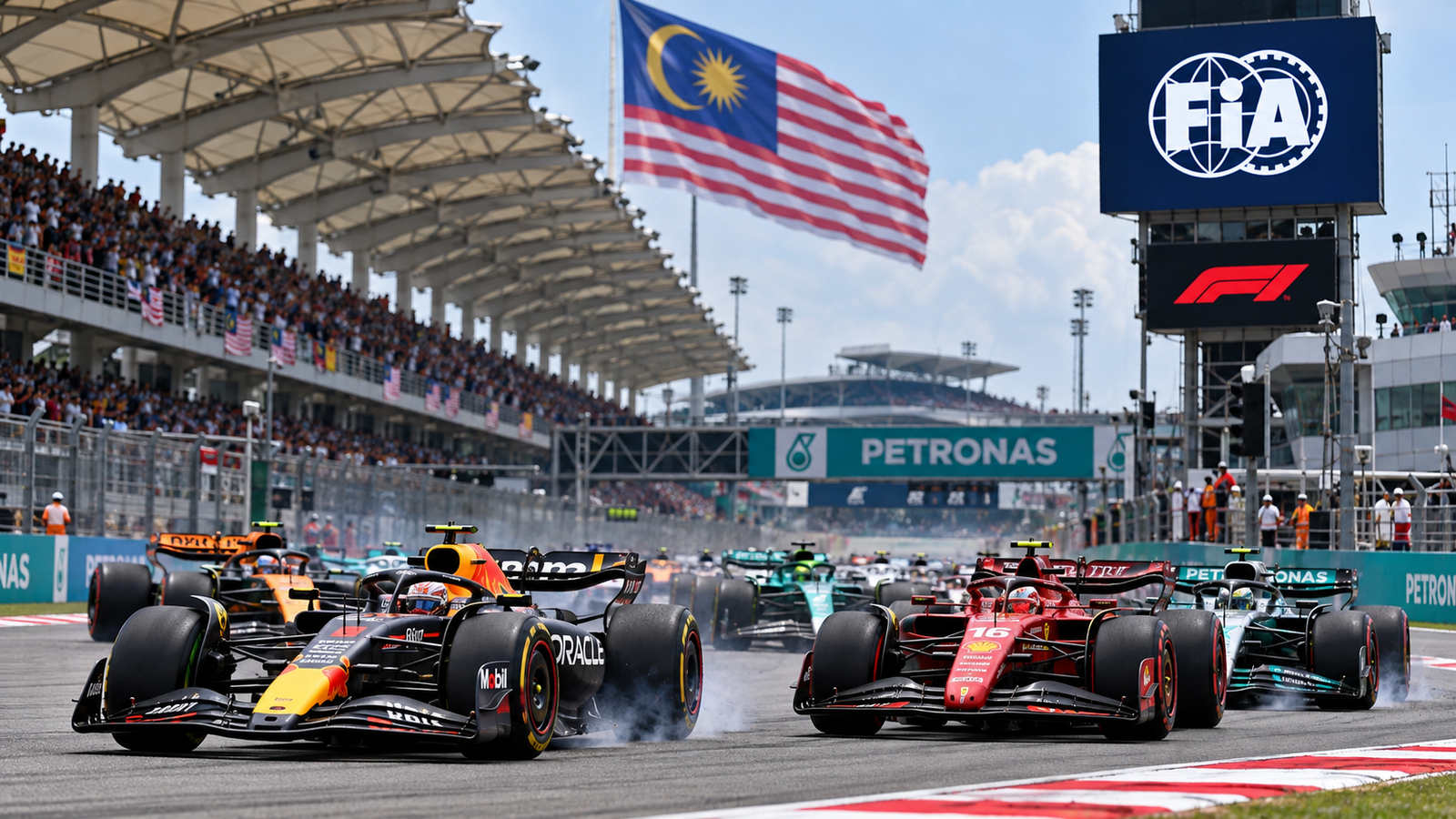
FIA software bug caused major confusion at the start of the 2026 Bahrain Grand Prix, which was held at Malaysia’s Sepang International Circuit on October 4 after the original Bahrain event was relocated. Several Formula 1 cars lost power during the formation laps in wet conditions, forcing officials to suspend the start while teams installed updated power-unit software.
The FIA has now completed its investigation into the incident. The governing body confirmed that cars running at very low engine speeds in particular circuit sectors, where a 250kW power reduction was applied for wet conditions, experienced a loss of power beyond what the software was designed to produce. The issue could not be recovered within those sectors.
The investigation also produced a clear response. The temporary configuration used at Sepang will be available again for the Singapore Grand Prix if similar wet conditions occur, while another wet-weather software update is scheduled before the United States Grand Prix on October 25.
Key Highlights
- The FIA has completed its investigation into the software problem at Sepang.
- Very low engine RPM combined with wet-weather energy restrictions triggered the unexpected power loss.
- The FIA identified the problem within minutes after the interrupted formation laps.
- Teams installed an emergency software configuration before the race restarted.
- A further wet-weather software update is planned for the United States Grand Prix.
Table of Contents
- What Happened?
- Important Details
- Why Is This News Important?
- Latest Updates
- Official Statement / Source
- Background / Context
- Reactions and Public Response
- What Happens Next?
- Frequently Asked Questions
- Conclusion
What Happened?
The FIA software bug became visible during the formation laps of the Bahrain Grand Prix at Sepang. Heavy rain had already delayed the original start, and drivers were completing the opening laps behind the Safety Car in difficult conditions.
The problem became particularly noticeable when cars slowed dramatically. Max Verstappen, who started from pole position, was among the first affected. Lewis Hamilton and several other drivers then experienced power-related problems as the field moved through the wet circuit. The situation became serious enough for the race-start procedure to be suspended.
According to the FIA’s completed investigation, the incident was linked to the interaction between low engine RPM, the wet-weather energy-management settings and the layout of Sepang’s sectors.
For wet conditions, the power-unit software applies an energy-management restriction. In the affected sectors, the electrical power limit was reduced to 250kW. The investigation found that some cars reached unusually low engine speeds while travelling slowly on the formation lap. Under that combination of conditions, the software produced an unintended loss of power.
The issue was not simply caused by rain. Instead, it required a particular combination of circumstances. Cars had to reach sufficiently low engine speeds in sectors where the wet-weather power restriction was active.
That explains why the problem did not affect every car in exactly the same way. Different cars reached different speeds at different points of the circuit, creating what FIA single-seater director Nikolas Tombazis described in post-race explanations as a combination of circumstances.
Once the problem appeared, FIA technical personnel moved quickly. The governing body says its technical team identified the cause within five minutes of the race-start suspension and issued revised Power Unit software configurations.
Teams then had to integrate the updated configuration into their cars. The process required technical guidance and clarification before all competitors were ready to return to the start procedure.
The race eventually got underway after the software change had been implemented. The incident therefore became less about a permanent mechanical failure and more about a software and wet-weather configuration problem that had not been fully exposed during testing.
Important Details
FIA Software Bug and the 250kW Restriction
The central technical detail is the wet-weather energy-management system.
The 2026 Formula 1 regulations introduced a new generation of power units with a much greater role for electrical energy. That makes energy management particularly important, especially when track conditions change.
In wet conditions, the FIA’s common software uses specific settings to reduce electrical power in certain parts of a circuit. At Sepang, the relevant restriction reduced electrical power to 250kW.
The FIA investigation found that the software behaved incorrectly when some cars entered those areas at very low engine RPM. Instead of allowing power to return normally, the affected cars experienced a deeper loss of power than intended.
Why Did Cars Slow Down?
The cars were travelling slowly because of the wet conditions and the formation-lap procedure behind the Safety Car.
Very low speeds created an unusual operating condition. As one car slowed, the cars behind it could also be forced to reduce speed, creating a chain effect through the field.
The FIA’s investigation specifically focused on the low engine speeds experienced in particular sectors. The problem was therefore connected to how the software responded to a situation that was not sufficiently represented in testing.
Why Was the Race Start Suspended?
The first start procedure was suspended at 15:45 local time after two formation laps produced multiple power-loss incidents.
Five minutes later, at 15:50, the FIA technical team had identified the cause and released revised software configurations. At 16:03, teams received additional technical guidance, while the integration process continued.
By 16:20, the teams and power-unit manufacturers had completed the integration process. The 10-minute signal was then issued at 16:22, and the cars left the pit lane at 16:33 for the race-start procedure.
The sequence shows why the delay lasted much longer than a normal red-flag interruption. This was not simply a matter of waiting for the rain to stop. Teams had to make a software change before the race could safely resume.
Was the Software Completely Untested?
No.
This point is important because early criticism suggested that the software had not been tested at all. The FIA specifically rejected that interpretation in its final review.
According to the governing body, teams and power-unit manufacturers carried out simulation exercises before implementation. The software was also tested during full-scale running in Free Practice 1 at the Belgian Grand Prix and Dutch Grand Prix.
The problem was that the testing did not reproduce the specific low-speed conditions that occurred at Sepang.
That distinction matters. The software had been tested, but the precise combination of very low speeds, wet conditions, energy restrictions and the Sepang sector configuration was not adequately represented.
Why Is This News Important?
The FIA software bug is significant because modern Formula 1 cars depend heavily on complex electronic systems to manage their power units.
A Formula 1 car is no longer controlled only through mechanical components. Software influences energy deployment, power management and how the hybrid system responds to changing circumstances.
The Sepang incident showed how an unusual operating condition can expose a weakness even when a system has already undergone testing.
It also demonstrated the difficulty of preparing software for wet-weather racing. The FIA said opportunities for wet running had been limited, which reduced the number of opportunities to test the software under the full range of possible conditions.
For Formula 1, the issue is therefore bigger than one delayed race start. The FIA now wants stronger software testing and verification procedures involving the governing body, teams, power-unit manufacturers and the supplier of the standardized Electronic Control Unit.
The FIA regulations already place strict requirements on electronic systems and software used by teams. The technical regulations also allow certain bug fixes and FIA-requested changes without increasing the relevant software-version count.
The Sepang incident provides a practical example of why those rules and validation processes matter.
It also matters for sporting confidence. Fans expect Formula 1 races to be decided by competition between drivers and teams rather than an unexpected common software problem. The FIA’s response is therefore important not only from an engineering perspective but also for maintaining trust in the sport’s technical systems.
Latest Updates
- October 4: The Bahrain Grand Prix at Sepang experienced a heavily disrupted start after several cars lost power during the wet formation laps.
- October 4: The FIA issued updated power-unit software configurations during the interruption so the race could resume.
- October 5: The FIA announced that it would conduct a full investigation into the incident.
- October 8: The FIA completed its investigation and confirmed that low engine RPM combined with the 250kW wet-weather restriction caused the unintended power-loss behaviour.
- Singapore Grand Prix: The Sepang configuration will be reinstated if similar wet conditions are expected.
- United States Grand Prix: A further wet-weather software update is planned for October 25.
Official Statement / Source
The FIA’s official investigation is the most important source for the latest findings. The governing body said the review examined the precise cause of the power losses, measures to prevent recurrence, wet-weather Power Unit settings and data supplied by teams and Power Unit manufacturers.
The FIA concluded that some cars operating at low engine RPM in sectors affected by the 250kW power reduction suffered power losses beyond the intended level.
The governing body also confirmed that the software had been tested before deployment. Simulation exercises were conducted by teams and power-unit manufacturers, while full-scale testing took place during Free Practice 1 at the Belgian and Dutch Grands Prix.
The FIA has also thanked the teams, power-unit manufacturers and its technical personnel for responding quickly during the Sepang interruption.
The full official report is available through the FIA investigation into the Bahrain Grand Prix formation-lap software bug.
Background / Context
The incident happened during an unusual 2026 Formula 1 calendar situation.
The Bahrain Grand Prix was held at Sepang in Malaysia after the original Bahrain event was relocated because of circumstances affecting the Middle East. That meant Formula 1 found itself racing at a circuit that had not originally been scheduled to host the Bahrain round.
Sepang is well known for its tropical climate and the possibility of heavy rain. That made wet-weather preparation particularly important.
The 2026 technical regulations also created a new power-unit environment. Electrical energy plays a significantly larger role than in previous Formula 1 generations, increasing the importance of software-based energy management.
The wet-weather configuration involved reducing electrical power to 250kW in specific sections. The purpose was connected to managing energy deployment in difficult conditions. The Sepang incident showed that the interaction between this restriction and very low engine speeds could create an unintended result.
The software itself was common to the cars rather than being a separate system developed independently by every team. The FIA worked with teams and power-unit manufacturers on the software, making the issue a sport-wide technical concern rather than a problem belonging to one constructor.
That is one reason the response required coordination across the grid.
When the formation-lap problems appeared, the FIA did not need to create an entirely new system from scratch. Instead, it modified the configuration to remove the energy constraint in the affected areas, allowing the race to proceed.
This was an emergency response rather than a final long-term solution.
The FIA’s later review therefore focused on how the wet-weather software should be managed in future races and how the testing process could be strengthened.
The FIA also acknowledged that software testing opportunities can be limited. Wet-weather running is not always available during race weekends, and teams cannot simply reproduce every possible combination of weather, speed, circuit sectors and power-unit conditions.
That makes simulation and validation especially important.
The organization now plans to strengthen software testing and verification. Its review includes independent assessment and collaborative feedback involving the teams, power-unit manufacturers and the supplier of the standardized ECU.
For readers following [Latest Sports News], the Sepang incident is a useful example of how modern sports technology can directly influence competition.
It also connects to a wider discussion around the complexity of the 2026 Formula 1 rules. The new cars are designed around a closer relationship between combustion power, electrical energy and sophisticated control systems.
That complexity can create performance gains, but it also increases the number of technical interactions that must be tested.
The FIA’s own 2026 technical regulations place strong controls around electronic systems and homologated software. Teams can only use custom software approved for their control applications, while the regulations specify limits and procedures around software versions.
The Sepang incident does not mean the entire software approach is unreliable. Instead, it highlights the importance of testing unusual operating conditions before they occur during a race.
The FIA’s response is particularly relevant because Singapore follows Malaysia on the calendar. Singapore can also experience wet conditions, so the governing body needed a temporary solution before the cars arrived there.
The FIA has confirmed that the configuration established for Sepang will be reinstated for Singapore if similar weather conditions are expected. A further software update is then planned for the United States Grand Prix on October 25.
For [F1 Racing News] readers, this creates a clear timeline: the immediate problem has been identified, the temporary solution remains available, and a more developed wet-weather update is scheduled later in October.
Reactions and Public Response
The incident attracted strong reactions from drivers and generated considerable discussion about the reliability and complexity of the new-generation cars.
Lewis Hamilton was among the drivers affected during the formation laps. Max Verstappen also experienced the problem, while the FIA later explained that not every car reached the same low speeds and therefore not every car was affected in the same way.
Verstappen later explained in the official post-race press conference that the car lost speed at very low speed and low RPM before recovering under normal circumstances. He also confirmed that the software update was responsible for the delay before the second start.
The response from the FIA has been to investigate the technical cause rather than blame individual teams.
That approach is important because the software was developed as a common system involving the FIA, teams and power-unit manufacturers.
The incident also produced debate among drivers and commentators about how much complexity Formula 1 should introduce into power-unit management. However, the FIA’s completed investigation provides a more specific technical explanation: the immediate problem was an unexpected interaction between low engine speed and the wet-weather energy restriction.
What Happens Next?
The next immediate test for the revised approach will come at the Singapore Grand Prix.
If wet conditions occur, the FIA has confirmed that the configuration used at Sepang will be reinstated. This is intended to avoid a repeat of the same software behaviour while the sport continues working on a more comprehensive update.
The next major software change is planned for the United States Grand Prix on October 25.
The FIA also intends to strengthen its testing and verification process. That includes greater validation of power-unit software, independent assessment and feedback from teams, manufacturers and the ECU supplier.
What remains uncertain is how the updated software will perform across every possible wet-weather scenario. The FIA has not suggested that every future situation can be predicted, but its investigation has identified a specific weakness and outlined measures to reduce the chance of recurrence.
For Formula 1, the important next step is therefore not simply installing another update. It is improving the process used to test software before it becomes part of race operations.
Frequently Asked Questions
What is the FIA software bug?
The FIA software bug was an unexpected power-management problem during the wet formation laps of the Bahrain Grand Prix at Sepang. Cars running at very low engine RPM in sectors with a 250kW electrical-power restriction experienced more power loss than intended. The FIA has now completed its investigation and confirmed the cause.
Why did the FIA software bug affect F1 cars in Malaysia?
The problem required several conditions to occur together. Cars were travelling unusually slowly on a wet formation lap, engine RPM fell very low, and wet-weather software restrictions were active in particular circuit sectors. The FIA said this combination produced an unintended loss of power that could not be recovered immediately.
Was the Formula 1 software tested before the Malaysia race?
Yes. The FIA confirmed that the software underwent simulation exercises involving teams and power-unit manufacturers. It was also tested during full-scale running in Free Practice 1 at the Belgian and Dutch Grands Prix. However, the specific very-low-speed conditions at Sepang were not adequately reproduced.
Why was the Bahrain GP held in Malaysia?
The Bahrain Grand Prix was relocated to Malaysia because of circumstances affecting the Middle East. The race was therefore held at the Sepang International Circuit rather than its originally scheduled venue. Heavy rain at Sepang then created the conditions in which the software issue became visible.
What software fix did the FIA use?
The FIA issued revised Power Unit software configurations during the race-start interruption. The emergency change removed the relevant energy-limit constraint in the circuit sectors where the low-speed condition had triggered the problem. Teams then integrated the updated configuration before the race restarted.
Will the FIA software bug happen again in Singapore?
The FIA has not said that a repeat is impossible, but it has taken steps to reduce the risk. If wet conditions are expected at Singapore, the configuration used at Sepang will be reinstated. A further wet-weather software update is scheduled for the United States Grand Prix.
When will the next wet-weather software update arrive?
The FIA has confirmed that a further wet-weather software update will be released for the United States Grand Prix on October 25. The organization is also strengthening its broader software testing and verification process with teams and power-unit manufacturers.
Why is the Malaysia incident important for Formula 1?
The incident highlights how important software has become to modern Formula 1 power units. A system can pass normal simulations and track testing while still encountering an unusual combination of conditions during a race. The FIA’s response is therefore focused on improving validation as well as fixing the specific issue.
Conclusion
The FIA software bug at Sepang exposed a specific weakness in the wet-weather power-management system used by the 2026 Formula 1 cars. The FIA has now identified the combination of low engine RPM and the 250kW power restriction that caused the unexpected loss of power.
The immediate problem was resolved during the Bahrain Grand Prix in Malaysia, while additional measures are being prepared for Singapore and the United States Grand Prix.
The key takeaway is simple: the software was tested, but not under the exact conditions that triggered the problem. The FIA’s next challenge is to make sure those unusual conditions are properly covered by future testing and validation.
For more latest sports news, match updates, and breaking sports stories, visit WorldPlayHub.
Latest Sports News, Scores & Updates — https://www.fia.com/news/fia-concludes-investigation-bahrain-gp-malaysia-formation-lap-software-bug