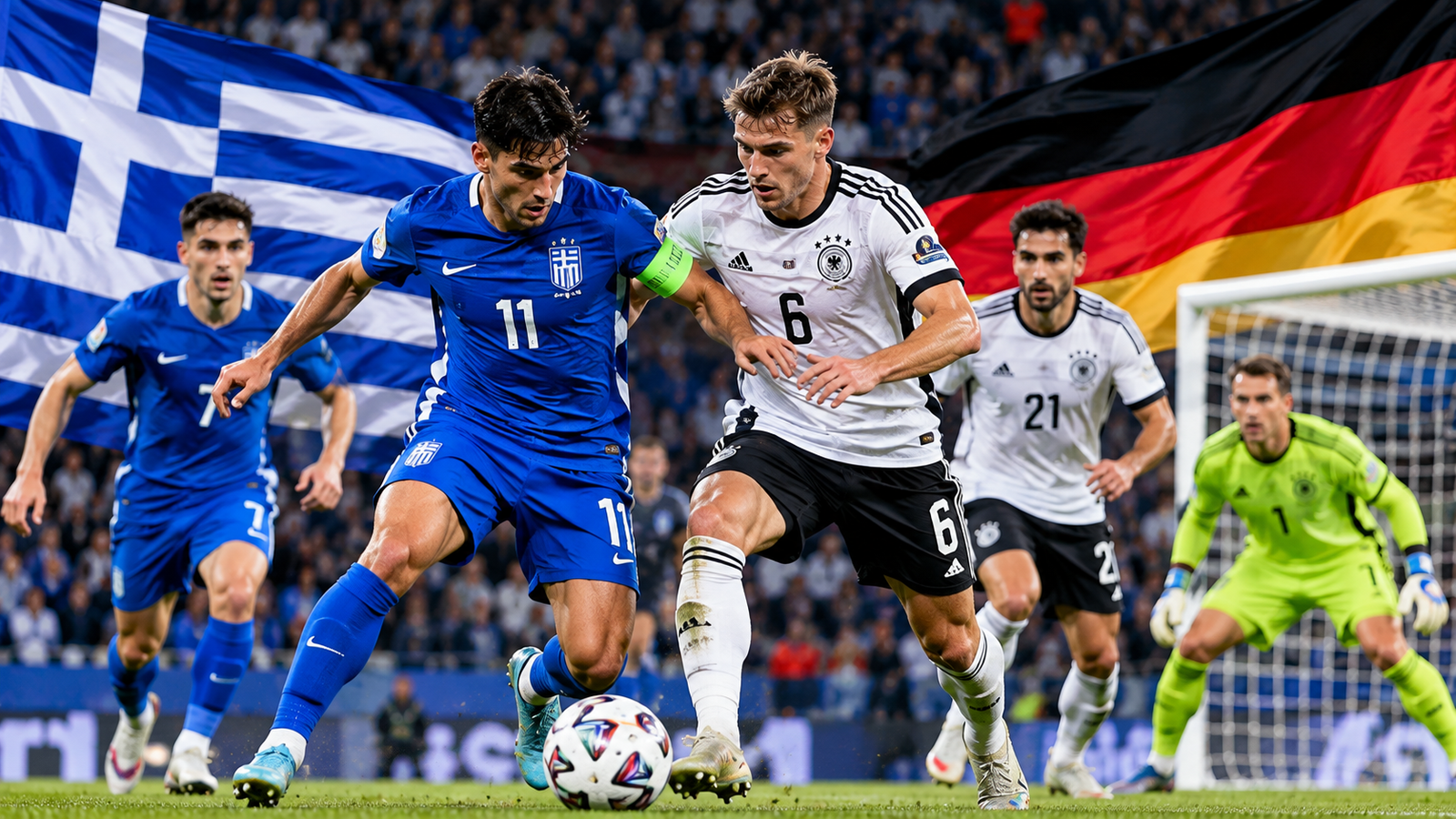
Greece vs Germany : The draw came only a week after Greece had beaten Germany 1-0, which made this rematch an immediate test of Germany’s response under Jürgen Klopp. Germany had entered the match after a 2-0 victory over Serbia, their first win of the Nations League campaign under Klopp, but Greece remained difficult to break down.
Greece vs Germany Match Result and Main Story
The final score was Greece 0-0 Germany. For Greece, the match delivered another valuable point and another clean sheet against one of Europe’s biggest national teams. For Germany, Greece vs Germany was another match in which effort and pressure were not converted into enough attacking output.
UEFA reported that Greece went close first when Giorgos Masouras had a header pushed away by Jonas Urbig. Germany then created most of the pressure in the first half and produced the other 15 attempts, with Kostas Tzolakis making an important save from David Raum.
That first-half pattern made the game look like a game Germany could eventually win, yet Greece stayed calm. After the break, the tempo dropped and neither side created the decisive moment. The hosts protected their shape and Germany struggled to turn possession into a clear scoring chance.
What Happened in Greece vs Germany
The match was played in Thessaloniki as part of Matchday 4 of the 2026/27 UEFA Nations League. Greece arrived unbeaten after winning against Serbia and Germany and drawing with the Netherlands. Germany had lost to Greece, drawn with the Netherlands and beaten Serbia before this fixture.
That made this encounter strategically important. Greece wanted to keep collecting points in their first League A campaign, while Germany needed another positive result to show that Klopp’s rebuilding process was moving in the right direction.
Germany started with more attacking intent. Their pressure was noticeable during the opening period, and the visitors spent long spells around the Greek penalty area. But Greece vs Germany also showed why territory alone is not enough. Greece defended in numbers, protected central areas and made Germany work for every opening.
Tzolakis was central to the plan. His save from Raum prevented Germany’s pressure from turning into a goal, while Urbig also responded well when Greece created their early opportunity. As the match went on, both goalkeepers became symbols of a contest decided by defensive concentration rather than attacking brilliance.
When and Where Was the fixture Played?
Greece vs Germany was played on October 4, 2026, in Thessaloniki, Greece. UEFA’s Matchday 4 report confirmed the 0-0 scoreline and noted that Greece stayed unbeaten after resisting Germany’s pressure.
The location mattered because Greece were able to use home support while operating with the confidence that had grown during their strong start. For a team making its first League A appearance in the Nations League, every home result carries extra weight.
For Germany, the draw was another test during a period of major transition. Reuters reported that Klopp has selected 44 players across four matches, including 16 newcomers, as he searches for the right balance and tries to build a new identity for the national team.
That level of experimentation can produce encouraging performances, but it can also make attacking combinations less settled. Germany looked more energetic than in some earlier moments of the campaign, yet the scoreline showed that the process is still unfinished.
Key Players in Greece vs Germany
Kostas Tzolakis was one of Greece’s most important players. He handled Germany’s strongest spell in the opening half and helped maintain another clean sheet. His save from Raum was particularly valuable because it kept the match level while Germany had momentum.
Giorgos Masouras also contributed to Greece’s early threat. His header tested Urbig and gave the hosts an early reminder that they did not need to dominate possession to create danger.
For Germany, Urbig made a key intervention when he denied Masouras. The goalkeeper’s contribution was important because an early Greek goal would have changed the tactical picture and forced Germany to attack against an even more defensive opponent.
Florian Wirtz was also part of Germany’s wider attacking effort, but the meeting again demonstrated that individual quality needs to be matched by better execution around the box. Germany could move the ball and create pressure, but they still needed a final pass, finish or moment of individual brilliance to decide the contest.
Greece’s Defensive Plan in Greece vs Germany
Greece’s approach was built around compact defending. The team kept the distance between its lines under control and avoided giving Germany large spaces to attack through. That structure was especially useful against Klopp’s high-intensity approach.
Reuters has described visible progress in Germany’s aggressive, high-tempo style, but Greece vs Germany showed that a disciplined opponent can reduce the value of that pressure by staying organized.
Greece also showed patience. Instead of pushing large numbers forward, they waited for moments to attack and focused on protecting the lead that did not exist but on preventing the deficit that could hurt them. That may sound simple, but it required concentration for the full match.
The clean sheet is significant because Greece have now taken two strong results against Germany in a short period. The first meeting finished 1-0 to Greece, while Greece vs Germany ended 0-0.
Germany’s Problem Was Not Effort, but End Product
The German performance under Klopp is becoming a story of improvement without enough reward. The Serbia win gave the team momentum, but Greece vs Germany produced another draw when Germany needed a stronger return.
The biggest issue was not a lack of effort. Germany pressed, circulated the ball and spent time in advanced areas. The problem was turning that control into clear, high-quality finishing opportunities.
That is likely to be one of Klopp’s biggest priorities before the next international window. Germany cannot depend on territorial dominance alone, especially when opponents are willing to defend deep and wait for mistakes.
The squad is also still being shaped. Klopp has given opportunities to new players, which Reuters said included 16 newcomers across the early matches. That approach can create long-term depth, but it can also mean that key attacking combinations take time to develop.
What the Group A2 Standings Mean After Greece vs Germany
After four matches, Greece and the Netherlands have eight points each, while Germany have five and Serbia have zero. Greece and the Netherlands remain unbeaten, while Germany have one win, two draws and one defeat.
For this result, that means Greece collected another point without losing ground at the top end of the group. The Greece vs Germany result does not guarantee qualification or a top-two finish, but it keeps the team in a strong position.
Germany’s five points leave them in third place. Reuters noted that their November fixtures against Serbia and the Netherlands will be important if they are to challenge for the top two positions.
The standings therefore make Greece vs Germany more significant than a routine 0-0. Greece are steadily collecting results, while Germany still need a run of wins to change the shape of the group.
Why Greece vs Germany Matters for Greece
For Greece, the draw is another indication that they can compete in League A. Their sequence so far includes wins over Serbia and Germany and draws against the Netherlands and Germany.
That means Greece vs Germany should be viewed as part of a consistent campaign rather than an isolated defensive display. Greece have shown they can adapt to different opponents and protect results even when they are under pressure.
The team is also giving young players valuable experience. UEFA previously highlighted promising names such as Tzolis, Tzolakis, Karetsas and Konstantelias.
Their progress could become an important story as the Nations League continues. A strong group campaign would give Greece confidence before future major tournaments and prove that they can challenge established European teams.
Why Greece vs Germany Matters for Germany
For Germany, the draw is frustrating because the performance contained positive signs. The side looked more aggressive and better organized than in some earlier moments, but the result remained modest.
Reuters reported that Klopp has just one win from his first four matches as Germany coach. He has still emphasized the progress he sees in the team’s intensity and development, but results remain the clearest measure of success.
That makes Greece vs Germany another lesson in the difference between performance and outcome. Germany can look improved and still drop important points if they do not finish chances.
The November window could therefore become a turning point. Strong results would reduce the pressure around Klopp and give the new squad a clear direction. Another set of disappointing results would raise more questions about how quickly the rebuilding project can deliver.
Tactical Lessons From Greece vs Germany
The first lesson from Greece vs Germany is that territorial control does not automatically lead to goals. Germany produced pressure, but Greece maintained enough defensive discipline to keep the score level.
The second lesson is the importance of goalkeeping. Tzolakis made the saves Greece needed, while Urbig prevented the hosts from taking the lead early.
The third lesson is patience. Greece did not try to copy Germany’s attacking volume. They focused on staying compact and making the match uncomfortable, which became more effective as the second half progressed.
From Germany’s point of view, Greece vs Germany highlighted the need for greater efficiency around the penalty area. The team can build pressure, but the next stage is converting that pressure into goals and victories.
The Bigger Picture Around Greece vs Germany
Germany entered this Nations League campaign after another early World Cup exit, and Klopp took charge in July 2026 with a major task of rebuilding confidence. Reuters noted that he has used a wide pool of players while searching for a more dynamic identity.
That context is important when judging Greece vs Germany. A 0-0 draw does not prove that Germany’s rebuild is failing, but it does show that the team still has important problems to solve in the final third.
For Greece, the picture is more straightforward. Their first League A campaign has delivered points against respected opposition and, after Greece vs Germany, their unbeaten record remains intact.
The hosts can now approach the next matches with confidence. They have already shown that they can defend a lead, survive pressure and compete against teams with greater international pedigree.
What Happens Next After Greece vs Germany
The next Nations League fixtures arrive in November. Germany are scheduled to face Serbia on November 13 and the Netherlands on November 16. Greece are due to meet the Netherlands on November 13 and Serbia on November 16.
Those matches will determine how valuable Greece vs Germany ultimately becomes. Greece will hope that another strong finish can secure their position among the leading teams in Group A2. Germany need points quickly if they want to move up from third.
The pressure is especially clear for Klopp. His first four matches have produced a draw with the Netherlands, a loss to Greece, a win over Serbia and another draw with Greece.
That record is not disastrous, but Greece vs Germany makes it clear that Germany need more consistent results. The November games will provide the next major evidence of whether Klopp’s ideas are beginning to translate into points.
Final Takeaway From Greece vs Germany
The 0-0 scoreline may not look dramatic, but Greece vs Germany carried plenty of significance. Greece stayed unbeaten, protected another clean sheet and reached eight points, while Germany avoided defeat but could not turn pressure into three points.
The main story is therefore the contrast between Greece’s consistency and Germany’s unfinished rebuild. Greece continue to show that they belong in League A, while Germany are still searching for the attacking efficiency and stability Klopp needs.
With the November fixtures ahead, the group remains open. Greece have built a strong foundation, the Netherlands remain at the top end of the race, and Germany still have a chance to respond. The latest draw leaves plenty to play for.
For more latest sports news, match updates, and breaking sports stories, visit WorldPlayHub.
Latest Sports News, Scores & Updates — SACHKIKHABAR