India vs West Indies: Shai Hope’s Record 162* Seals Historic Five-Wicket Win
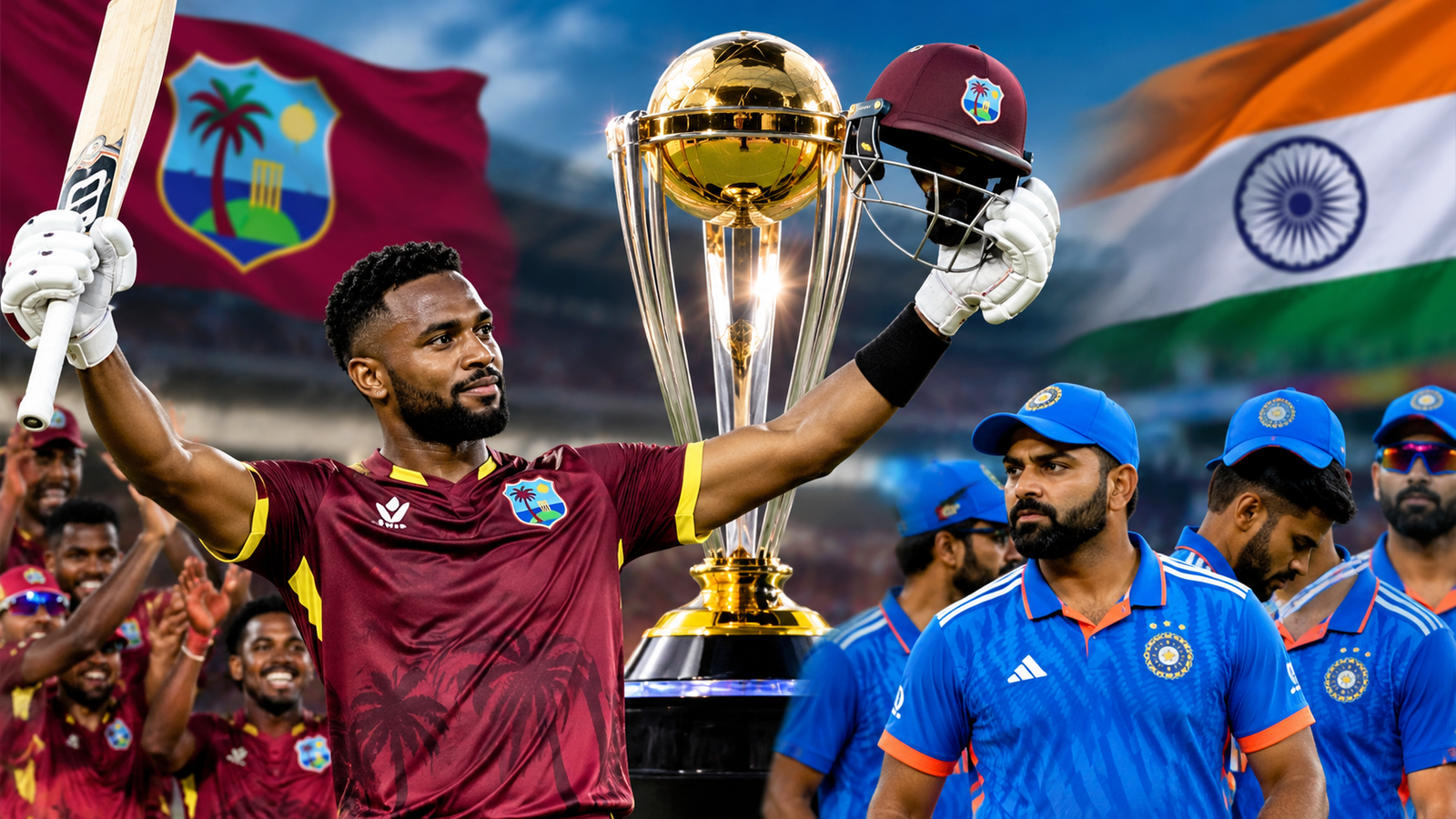
The India vs West Indies third ODI delivered one of the biggest surprises of the series as West Indies chased down India’s 352-run target to win by five wickets in New Chandigarh on Saturday, October 3, 2026. Shai Hope produced a remarkable unbeaten 162 to lead the chase, while India were left to reflect on a missed opportunity after posting 351 for 7.
India had already secured the three-match ODI series by winning the first two games, but West Indies refused to finish the tour without a victory. Hope’s outstanding innings took West Indies to 352 for 5 in 48.2 overs, with the visitors reaching the target with 10 balls remaining. It was West Indies’ highest successful ODI run chase and their first ODI victory over India since 2023.
The result brought an unexpected ending to a series in which India had looked dominant through the opening two matches. India had won the first ODI by eight wickets and then completed a record chase of 406 in Guwahati, with Shubman Gill scoring an unbeaten 223 in the second match. But the third ODI belonged to Hope and West Indies.
For India, there were still positives with the bat. KL Rahul returned to the middle order and scored an unbeaten 129, while Rohit Sharma made 92 and Ruturaj Gaikwad added 57. Rahul’s century also helped him cross 10,000 international runs, making him the 15th Indian batter to reach that milestone.
The main concern for India came with the ball and in the field. A total of 351 should normally give a team a strong chance of winning an ODI, but India’s attack struggled to stop Hope’s counterattack. Captain Shubman Gill later pointed to fielding and death bowling as areas that need improvement.
India vs West Indies: What Happened?
The third ODI began with India winning the toss and choosing to bat first at the PCA International Cricket Stadium in New Chandigarh.
India’s decision initially appeared to make sense. The pitch offered plenty for batters, and the team had already produced two huge scores earlier in the series.
But the opening overs immediately created a different story.
Shubman Gill was dismissed for just one run, while Virat Kohli was removed for a golden duck. India were suddenly 4 for 2, and West Indies had a chance to put the hosts under serious pressure.
That early setback brought Rohit Sharma and Ruturaj Gaikwad together.
India vs West Indies: The experienced Rohit started carefully and gradually increased the tempo. Gaikwad also settled into his innings, and the pair rebuilt India’s innings with a 137-run partnership for the third wicket.
Rohit eventually fell for 92 from 85 balls, narrowly missing another ODI century. His innings included 10 fours and three sixes.
Gaikwad continued until he reached 57 from 69 deliveries, giving India the stability they needed after the early collapse.
The stage was then set for KL Rahul.
Rahul came into the game after not batting in India’s first two matches, and he made his return count. He took responsibility for the middle and lower order, gradually increasing the scoring rate as the innings moved toward the final overs.
Rahul reached his ninth ODI century from 80 balls and finished unbeaten on 129 from 87 deliveries. He struck 10 fours and six sixes, according to the ICC’s match report.
His century also took him beyond 10,000 international runs.
India finished with 351 for 7 from their 50 overs, a total that looked strong enough to put West Indies under serious pressure.
The match, however, was about to take a completely different direction.
West Indies Produce a Record Chase
West Indies needed 352 runs to win.
The target was large, but Shai Hope approached the chase as though the pressure belonged to India.
India vs West Indies: Hope returned to the top of the order and attacked early. He combined timing with controlled aggression, finding boundaries without taking unnecessary risks.
John Campbell also started positively before Mohammed Siraj removed him in the fifth over.
Instead of slowing down, West Indies continued to attack.
Amir Jangoo joined Hope and helped maintain the required run rate. The pair formed a crucial partnership that completely changed the mood of the chase.
Hope was particularly strong against India’s slower bowlers.
He used his feet well, looked for gaps and attacked whenever India missed their lengths.
By the end of the first 10 overs, West Indies had already put themselves in a strong position.
The visitors reached 148 for 1 after 20 overs, keeping the asking rate under control.
That was the point when the chase began to look genuinely possible.
Shai Hope Takes Control
Shai Hope was the central figure of the entire match.
India vs West Indies: He had already kept wicket for India’s entire innings. Instead of showing signs of fatigue, he walked out to open West Indies’ chase and immediately took responsibility.
His innings became a lesson in ODI batting.
Hope did not try to hit every ball.
He understood that West Indies needed to stay ahead of the required rate while preserving wickets.
That balance allowed him to bat deep into the innings.
Amir Jangoo also played an important role.
The wicketkeeper-batter scored 67 runs, giving Hope the support he needed during the middle overs. Their partnership ensured West Indies did not need an extraordinary finish from several players.
Once Hope reached his hundred, the pressure shifted almost completely onto India.
The fielding side needed wickets, but the chances did not consistently go their way.
Hope continued finding boundaries and kept the scoreboard moving.
Even when India briefly created pressure near the end of the innings, Hope remained in control.
Hope’s 162 Becomes a Record
Hope finished the chase unbeaten on 162 from 143 balls.
His innings was not just another ODI century.
It entered the record books.
India vs West Indies: The ICC confirmed that Hope’s 162 was West Indies’ highest successful ODI run chase by an individual batter, surpassing Brian Lara’s 153 against Pakistan in 1993.
It was also the highest score by a West Indies men’s batter in a successful ODI chase against India.
That makes the innings particularly significant because Hope achieved the milestone against one of the strongest ODI sides in international cricket.
He also became only the second batter in the series to make a score above 150 in a chase after Shubman Gill’s 223 not out in the second ODI.
The difference was that Gill’s huge innings helped India win.
Hope’s equally important innings changed the result in West Indies’ favour.
KL Rahul’s Century Was Not Enough
KL Rahul had produced what looked like a match-winning innings.
Coming into bat with India in trouble, he steadied the innings, built partnerships and accelerated in the final overs.
India vs West Indies: His unbeaten 129 was his ninth ODI century, and the milestone also took his international tally beyond 10,000 runs. He became the 15th Indian cricketer to reach that mark.
Rahul also became only the third Indian batter to score at least 129 while batting at No. 5, behind Yuvraj Singh and MS Dhoni, according to the Economic Times report.
What made the innings especially impressive was the situation in which Rahul played it.
India were 4 for 2.
Gill and Kohli were already back in the dressing room.
Instead of allowing the innings to fall apart, Rahul stayed until the end and accelerated heavily during the final overs.
India scored 105 runs during the last 10 overs, and Rahul played a major part in that acceleration.
It looked like an innings that would decide the match.
But Hope had another plan.
Rohit Sharma’s 92 Gives India Stability
Rohit Sharma played one of the most important innings of India’s first half.
After the early wickets of Gill and Kohli, Rohit could not afford to attack blindly.
He had to rebuild the innings and make sure India had enough batting available for the later overs.
He did exactly that.
Rohit brought up his half-century from 58 balls before increasing the scoring rate.
He eventually scored 92 from 85 balls, with 10 fours and three sixes.
His dismissal was a disappointment because he was only eight runs away from another ODI century.
Still, his partnership with Gaikwad was crucial.
Without that 137-run stand, India’s total might have been considerably lower.
The irony of the match was that India’s batting produced enough runs to win, but the bowling could not defend them.
Ruturaj Gaikwad Makes Another Useful Contribution
India vs West Indies: Ruturaj Gaikwad continued his good series by scoring 57 from 69 balls.
His innings was less explosive than Rahul’s, but it was important because India needed stability after losing Gill and Kohli.
Gaikwad played his shots when the opportunities appeared but also stayed patient during the rebuilding phase.
He eventually fell after reaching another half-century, but by then he had helped India recover from 4 for 2.
His performance added another useful contribution to India’s increasingly deep ODI batting group.
India’s Bowling Struggles
The biggest question after the match was not about India’s batting.
It was about the bowling.
India vs West Indies: Giving away 352 after scoring 351 is a major warning sign, especially for a team building toward the 2027 ODI World Cup.
Mohammed Siraj provided the first breakthrough when he removed Campbell.
Kuldeep Yadav later found a wicket.
Naman Dhir and Gurnoor Brar also claimed one wicket each.
But India could not maintain pressure for long enough.
West Indies were able to keep scoring throughout the chase.
Even when a wicket fell, Hope remained there.
That became the defining difference between the two sides.
The Slow-Over Rate Also Became Important
Another important part of the final stages was India’s over rate.
India vs West Indies: Indian captain Shubman Gill later said his team had fallen around four overs behind the required rate, which affected the fielding setup during the final part of the chase.
India vs West Indies: With an additional fielder required inside the circle, Hope was able to take advantage of the conditions and find boundaries at a critical stage.
This may look like a small detail, but in a high-scoring ODI, small tactical changes can have a major impact.
India were already struggling to find wickets.
The fielding restriction made it harder to protect boundary areas.
Hope immediately took advantage.
India vs West Indies: The result was a reminder that an ODI match is not only about runs and wickets. Over rates, field placements and decision-making during the final 10 overs can determine the result.
Fielding Gives India Another Concern
Gill also highlighted India’s fielding after the defeat.
India vs West Indies: The captain acknowledged that the team’s fielding needed improvement and that too many opportunities had gone down during the match. He also identified death bowling as another area that required work.
That is particularly relevant because India are preparing for the 2027 ODI World Cup.
A strong batting lineup can win many matches, but tournament cricket often comes down to small moments.
India vs West Indies: A dropped catch can keep a dangerous batter at the crease.
A poor final over can turn a defendable total into a losing score.
India experienced both kinds of pressure during this match.
Anshul Kamboj’s ODI Debut
India vs West Indies: The third ODI also marked a significant moment for Anshul Kamboj, who made his ODI debut after Prasidh Krishna was ruled out with a left hamstring injury. BCCI had announced Kamboj as Krishna’s replacement before the match.
Kamboj was introduced into the attack during a difficult period of the match.
The situation was not easy for a debutant.
West Indies were chasing a large total, Hope was well set and the required rate remained manageable.
India vs West Indies: According to the Indian Express report, Kamboj conceded 41 runs from five overs.
A debut can be difficult under those circumstances, and one match does not define a young bowler’s career.
The important point for India is that the team now has another player with ODI experience to assess during the longer preparation period.
When Was India vs West Indies Played?
The third ODI was played on Saturday, October 3, 2026, at New Chandigarh.
It was the final match of the three-game ODI series between India and West Indies.
India had already won the first two matches, so the series was secured before the final game.
India vs West Indies: The third ODI therefore gave West Indies one final opportunity to avoid a clean sweep.
They took that opportunity in dramatic fashion by completing the chase with 10 balls remaining.
The result meant India won the series 2-1, while West Indies finished the ODI leg of the tour with a major victory.
Where Was India vs West Indies Played?
India vs West Indies: The match was played at the PCA International Cricket Stadium in New Chandigarh, Punjab.
The stadium became the setting for one of the biggest ODI run chases in West Indies cricket.
India scored 351.
West Indies responded with 352 for 5.
The final margin was five wickets, and the visitors completed the chase in 48.2 overs.
The pitch proved excellent for batting, especially once the early movement disappeared.
Both teams demonstrated that big totals were possible at the venue.
However, West Indies managed the conditions better when the pressure increased.
Why the Result Matters for West Indies
The victory was important for West Indies for several reasons.
First, it prevented India from completing a 3-0 clean sweep.
Second, it gave the visitors confidence after India had dominated the first two matches.
Third, it demonstrated that their batting lineup can chase a huge total against one of the world’s strongest ODI sides.
India vs West Indies: Most importantly, the victory came through a collective batting performance rather than one isolated cameo.
Hope scored 162.
Jangoo scored 67.
Other batters contributed enough to keep the chase moving.
The result could therefore provide confidence for the team going into the upcoming T20I series.
West Indies’ Highest Successful ODI Chase
The biggest statistical headline from the match is West Indies’ record chase.
India vs West Indies: They successfully chased 352, their highest successful run chase in men’s ODI cricket.
Their previous highest successful chase was 331 for 5 against Ireland in Malahide in 2019.
India vs West Indies: Breaking that record against India makes the result even more significant.
It also shows the scale of the task they completed.
India’s 351 looked competitive.
In most situations, such a score would put huge pressure on the chasing side.
West Indies instead reached the target with 10 balls remaining.
That is a remarkable turnaround considering how the series had gone before the final match.
Hope Breaks a 33-Year-Old West Indies Record
India vs West Indies:Shai Hope’s individual achievement is equally important.
His unbeaten 162 became the highest score by a West Indies batter in a successful ODI chase.
The previous record was held by Brian Lara, who scored 153 against Pakistan in Sharjah in 1993.
That puts Hope’s innings in an important place in West Indies ODI history.
Lara is one of the most celebrated batters in the history of the game.
To surpass one of his records in a successful chase against India makes Hope’s performance even more memorable.
The knock was also his fifth ODI century against India, according to the Indian Express report.
Amir Jangoo’s Important 67
India vs West Indies: While Hope dominated the headlines, Amir Jangoo’s 67 should not be overlooked.
He provided exactly what Hope needed after Campbell’s early dismissal.
The pair’s partnership gave West Indies stability and kept the required rate within reach.
Jangoo also continued a productive run in the series.
The India Today report noted that this was his third consecutive fifty-plus score in the series.
That consistency is valuable for West Indies because it gives the middle order a stronger platform.
Hope could then play the anchor role while Jangoo took more responsibility for scoring quickly.
Jayden Seales Stands Out With the Ball
Jayden Seales was one of West Indies’ most effective bowlers.
India vs West Indies: He took 3 wickets for 62 runs and played a key role in India’s difficult beginning.
His biggest moment came during the opening overs when he removed Shubman Gill and Virat Kohli in quick succession.
Gill was dismissed for one, while Kohli was out for a golden duck.
Those two wickets gave West Indies early hope.
India eventually recovered, but Seales had already done the most important thing for his team: putting pressure on India’s top order.
His three-wicket performance was a major contribution to West Indies’ eventual victory.
The Series Still Belongs to India
Despite losing the third ODI, India won the series 2-1.
That distinction matters.
India dominated the first two games.
In the opening ODI, India won by eight wickets.
India vs West Indies: In the second ODI, India produced one of the biggest successful ODI chases ever seen, chasing 406 and winning by eight wickets. Shubman Gill scored an unbeaten 223 in that match.
The third game therefore does not erase India’s series success.
Instead, it provides both teams with different lessons.
India need to fix their bowling and fielding problems.
West Indies can take confidence from a record chase.
For a three-match series, both sides leave with something to work on and something to celebrate.
Shubman Gill’s Series Performance
India captain Shubman Gill finished the ODI series as one of the leading run scorers.
He scored 334 runs across the three matches, including a century and his record-breaking double hundred in Guwahati.
India vs West Indies: According to reports following the series, Gill also matched MS Dhoni and Yuvraj Singh by claiming his seventh Player of the Series award in ODIs for India.
His contribution was therefore one of the major positives for India.
India vs West Indies: Gill did not have a good third ODI, being dismissed for one, but his overall series remained extremely strong.
That is an important lesson from a bilateral series.
One poor match does not cancel out two outstanding performances.
India vs West Indies: At the same time, India will want their captain to learn from the third ODI because it exposed areas that could matter against stronger opponents.
What the Series Says About India’s World Cup Preparation
India are using the current home season as part of their preparation for the 2027 ODI World Cup.
That makes the third ODI more than just a dead rubber.
The result highlighted several areas that India will need to address.
The batting remains a major strength.
Gill, Rohit, Rahul and other middle-order players have shown that India can build or chase very large totals.
India vs West Indies: The bowling, however, requires more consistency.
India have to identify reliable options for the middle overs and death overs.
They also need to improve their fielding standards.
Gill himself pointed to death bowling and fielding as areas for improvement after the defeat.
Those are issues that can be fixed before the World Cup, but the third ODI provided a useful warning.
What Happens Next for India?
The ODI series is finished, but the India vs West Indies tour is not over.
The next contest is the five-match T20I series.
India vs West Indies: The first T20I is scheduled for October 6, 2026, in Lucknow at the Bharat Ratna Shri Atal Bihari Vajpayee Ekana Cricket Stadium.
The remaining T20Is are scheduled for Ranchi on October 9, Indore on October 11, Hyderabad on October 14 and Bengaluru on October 17.
India’s T20I squad is different from the ODI group.
India vs West Indies: Shreyas Iyer will captain the T20I side, while Abhishek Sharma, Vaibhav Sooryavanshi, Ishan Kishan, Sanju Samson and Tilak Varma are among the players included.
That means the focus will now move away from Gill, Rohit and Rahul and toward India’s T20 group.
KL Rahul’s Next Challenge
KL Rahul’s 129 not out gives him plenty of momentum, but he is not part of the announced T20I squad for the West Indies series.
India vs West Indies: His immediate ODI performance, however, will strengthen the case for his continued involvement in India’s 50-over plans.
The 10,000-run milestone is another major career achievement.
Rahul has now crossed a mark reached by only a select group of Indian international batters.
His latest century also demonstrated that he remains capable of taking responsibility when India’s top order fails.
That could be important in future ODI series.
What Happens Next for West Indies?
India vs West Indies: West Indies will also move from ODI cricket into the five-match T20I series.
The first game is in Lucknow on October 6.
The series will give West Indies another opportunity to build confidence after the memorable third ODI.
The team can take several positives into the shorter format.
Hope’s form is obviously one.
Jangoo’s consistency is another.
Seales’ ability to take early wickets also remains important.
The major question will be whether West Indies can carry the confidence of the record ODI chase into T20 cricket.
The formats are different, so there is no guarantee.
But winning the final ODI in such a convincing way provides a much better platform than leaving India after three consecutive defeats.
Important Facts About India vs West Indies 3rd ODI
The third ODI was played on October 3, 2026 in New Chandigarh.
West Indies defeated India by five wickets.
India scored 351 for 7 in 50 overs.
West Indies reached 352 for 5 in 48.2 overs.
Shai Hope scored 162 not out from 143 balls.
Amir Jangoo scored 67.
KL Rahul scored 129 not out from 87 balls.
Rohit Sharma scored 92.
Ruturaj Gaikwad scored 57.
Jayden Seales took 3 for 62.
West Indies completed their highest successful ODI run chase.
Hope’s 162 was the highest successful chase score by a West Indies men’s batter, surpassing Brian Lara’s 153 from 1993.
India still won the three-match ODI series 2-1.
The first T20I between India and West Indies is scheduled for October 6 in Lucknow.
Why This Match Will Be Remembered
India vs West Indies: The third ODI had almost everything an ODI fan wants.
There were centuries.
There was a record chase.
There were early wickets.
There was a comeback.
There was pressure at the death.
And there was a player who stayed at the crease until the job was finished.
India recovered from 4 for 2 to post 351.
West Indies responded by chasing the target with 10 balls still remaining.
Hope played nearly the entire match.
He kept wicket during India’s innings and then batted through the entire chase.
That level of endurance made his performance even more impressive.
Final Take
The India vs West Indies third ODI ended with one of the biggest surprises of India’s 2026 home season.
India vs West Indies: India posted 351 for 7, with KL Rahul producing an unbeaten 129, Rohit Sharma scoring 92 and Ruturaj Gaikwad making 57. Rahul’s century also took him past 10,000 international runs.
But West Indies responded with a historic chase.
Shai Hope remained unbeaten on 162, while Amir Jangoo scored 67. West Indies reached 352 for 5 in 48.2 overs to win by five wickets.
Hope’s innings will be remembered as one of the finest ODI performances by a West Indies batter against India.
India vs West Indies: It gave West Indies their highest successful ODI chase and broke Brian Lara’s long-standing record for the highest individual score in a successful West Indies chase.
For India, the defeat does not change the series result.
They still won 2-1.
The first two victories showed the strength of India’s batting, especially through Gill’s huge score in Guwahati.
But the final ODI exposed weaknesses that need attention.
The bowling attack struggled to defend 351.
The fielding was not at the required standard.
The team’s over-rate also became an issue late in the chase.
Shubman Gill admitted after the match that India need to improve their fielding and death bowling as they continue preparing for the 2027 ODI World Cup.
For West Indies, the final result offers a completely different feeling.
They leave the ODI series 2-1 down, but with a historic victory that could give the team confidence before the T20I series.
The next chapter begins on October 6 in Lucknow.
India will want a quick response.
West Indies will want to build on their record-breaking ODI win.
And after what happened in New Chandigarh, the T20I series now has a little more interest than it did before the final ODI.
For Indian cricket fans, the main takeaway is clear: India won the series, but West Indies won the final statement.
India vs West Indies: Shai Hope’s 162 not out turned a 352-run target into a historic five-wicket victory and gave West Indies one of their biggest ODI wins of the year.
For more latest sports news, match updates, and breaking sports stories, visit WorldPlayHub.
For official tournament updates and the latest information on cricbuzz